
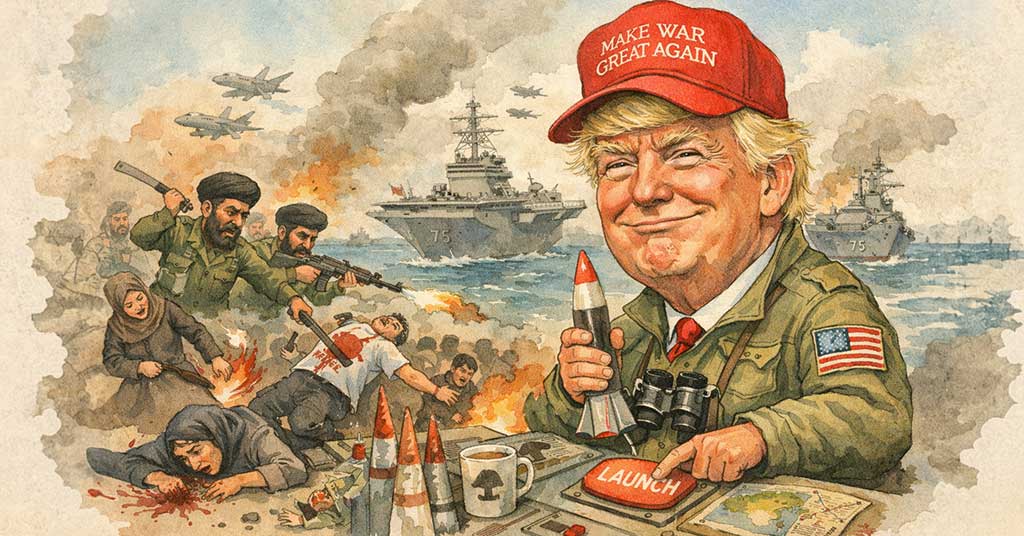
If Trump’s Iran gamble fails, the illusion of unchallenged U.S. power collapses

U.S. President Donald Trump has sent an American armada toward Iran, gambling lives and credibility on a dangerous illusion that the United States still commands a unipolar world that no longer exists.
In 1588, the Great Spanish Armada experienced a significant defeat off the coast of England. While the Spanish Empire did not collapse at that moment, it could no longer claim naval dominance. Historians for centuries have recognized the importance of the defeat of the Spanish galleons in the rise of the British Empire.
Are we watching a similar decline of the American Empire? Why is the Trump administration taking such a significant risk?
No one would dispute the power of the American military. Its air force is second to none, its navy is powerful, and it has an enormous cache of nuclear weapons. But everyone else knows it too.
There are reports that both Russia and China have equipped Iran with air defence systems. In June, tensions between Israel and Iran escalated into a direct exchange of airstrikes and missile attacks. Israel struck targets inside Iran, including military and nuclear-linked sites, and Iran responded with hundreds of ballistic missiles and drones aimed at Israeli territory. Israeli air defences intercepted many of the incoming projectiles, but a significant number penetrated and struck populated areas, causing casualties and infrastructure damage.
The episode underscored a larger shift: the United States no longer acts alone, and its rivals no longer stand alone either.
Yet overwhelming force has not translated into decisive victories. The Americans and their allies have not won a war in decades.
U.S. and allied forces withdrew from Afghanistan in August 2021 after 20 years of war. The 2003 invasion of Iraq was followed by years of insurgency, counterinsurgency operations and continuing instability that persists today. The number of countries willing to join the Americans in their conflicts is waning, as seen when several NATO members declined to participate in the 2003 invasion of Iraq.
Israeli military forces, which receive unrestrained backing from the Americans, have failed to gain control in Lebanon or even Gaza, even though they are not fighting against regular armies.
Retired U.S. Army officer Col. Douglas Macgregor points out that there is no doubt that U.S. forces can inflict significant damage on Iran. But damage is not the same as control. Just as the Spanish discovered in 1588, war is unpredictable. Once it begins, you do not control the outcome. Macgregor stated rhetorically, “You’re in a hell of a position, Mr. President. The military has done everything you asked it to do and can do. What do you do if it doesn’t work? And I don’t think this will.”
Washington can no longer assume it controls how these conflicts end.
Before regaining office in 2025, Trump was outspoken against armed conflicts and regime change operations. Many times he said, “We must abandon the failed policy of nation-building and regime change.” If the United States now moves toward another major confrontation, it would mark a sharp break from those promises and deepen the perception that Washington’s foreign policy appears driven less by strategy than by impulse.
What of those who voted for Trump expecting a president who would not engage in foreign conflicts? Will they support a government policy that will try to send their young people to war? What happens if Iranian missiles sink a U.S. aircraft carrier?
This gamble is unfolding at a moment when Trump’s authority is already under strain at home. According to a 2025 Pew Research Center survey, 73 per cent of Americans do not approve of most or all of his plans. The U.S. Supreme Court has ruled that Trump can no longer impose tariffs at will.
A similar pattern of resistance is visible beyond the Middle East. The world is reacting to American efforts to cut off the island nation of Cuba from fuel and supplies in an effort to cause the overthrow of its government. The U.S. embargo against Cuba began in the early 1960s under President Dwight D. Eisenhower and President John F. Kennedy, and Washington has strengthened its restrictions in recent years.
As shortages have worsened in Cuba, Mexico has sent shipments of food and fuel, Russia has pledged oil deliveries, and even Canada has debated providing humanitarian supplies. Other countries are no longer lining up behind Washington, and some are openly pushing back.
Clearly, we no longer live in the unipolar world that began with the fall of the Soviet Union in the early 1990s, a period when the United States faced no rival superpower. China is now the world’s second-largest economy, and Russia remains a nuclear superpower.
A new multipolar world, one shaped by competing powers such as China, Russia and regional blocs, will continue to evolve, with or without American approval. The question is, how many lives need to be lost before the warmongers in the Trump administration are convinced that American hegemony has ended?
Gerry Chidiac specializes in languages and genocide studies and works with at-risk students. He received an award from the Vancouver Holocaust Education Centre for excellence in teaching about the Holocaust.
Explore more on U.S. politics, Trump administration, Islamofascism
The views, opinions, and positions expressed by our columnists and contributors are solely their own and do not necessarily reflect those of our publication.
Troy Media empowers Canadian community news outlets by providing independent, insightful analysis and commentary. Our mission is to support local media in helping Canadians stay informed and engaged by delivering reliable content that strengthens community connections and deepens understanding across the country.

