
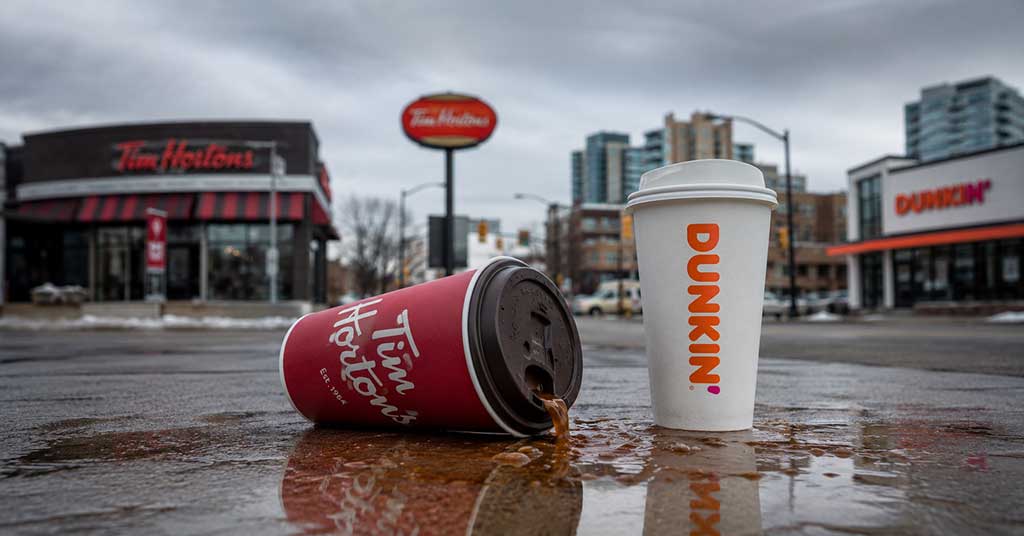
Dunkin’ Donuts’ return signals Tim Hortons is losing its dominance in the coffee market
For years, Dunkin’ Donuts’ collapse in Canada was viewed as one of the great business failures in the country’s food-service sector. Once a formidable rival to Tim Hortons, especially in Quebec, Dunkin’ gradually disappeared from the Canadian landscape before officially exiting in 2018. Many assumed the brand was gone for good.
Now it’s coming back.
The decision by Foodtastic to revive Dunkin’ in Canada is not really about donuts. It is about identifying weakness in a market that, for decades, looked untouchable.
For years, Tim Hortons dominated Canada’s quick-service coffee market. It wasn’t just a coffee chain; it became part of Canada’s cultural identity. But dominance can create complacency, and the Canadian marketplace today is very different from the one Dunkin’ left behind.
Consumer loyalty has weakened. Canadians are far more willing to switch brands than they were 20 years ago. Inflation has changed buying habits. Consumers are increasingly critical of value, quality, consistency and service.
Coffee is no longer simply about caffeine and donuts.
Today’s market revolves around specialty beverages, convenience, digital ordering, customization and the overall brand experience. Starbucks owns the premium coffee space. McDonald’s has become a major coffee competitor in Canada. Independent cafés are thriving in many urban centres.
Meanwhile, Tim Hortons still commands enormous market share, but it no longer owns the loyalty of Canadian consumers the way it once did.
Montreal-based restaurant consolidator Foodtastic, which operates dozens of restaurant brands and hundreds of locations across Canada and has built a reputation for aggressively acquiring and revitalizing brands, sees an opening.
Pita Pit, Second Cup, Freshii and Quesada are all examples of Foodtastic betting on established brands with fading momentum but strong consumer recognition. Dunkin’ fits perfectly into that strategy.
Unlike many foreign operators trying to enter Canada, Foodtastic actually understands the Canadian and Quebec markets intimately.
That matters.
Many Canadians forget how significant Dunkin’ once was in Quebec. At one point, the chain operated hundreds of locations and had genuine consumer loyalty. Older consumers still remember it fondly.
Nostalgia alone will not guarantee success, but it certainly lowers the barrier to re-entry.
The bigger question is whether Canada’s coffee market can realistically support another major player.
It will not be easy.
Canada is arguably one of the most competitive coffee markets in the world on a per-capita basis. Tim Hortons remains a giant. McDonald’s has quietly built one of the strongest coffee programs in the country. Starbucks dominates affluent urban consumers. Convenience stores have upgraded their offerings dramatically. Even grocery stores are now competing more aggressively with ready-to-drink beverages and premium beans.
But Foodtastic is likely betting on something very specific: a more fragmented coffee market.
The Canadian consumer today is less loyal, more price-sensitive, more curious and more willing to experiment than at any point in the last two decades. That creates opportunity for challenger brands.
Ironically, Dunkin’s return may say less about the strength of Dunkin’ itself and more about the reality that Tim Hortons is no longer viewed as invincible.
That alone makes this story worth watching carefully.
Dr. Sylvain Charlebois is senior director of the Agri-Food Analytics Lab at Dalhousie University, co-host of The Food Professor Podcast and visiting scholar at McGill University.
Explore more on Retail, Competition
The views, opinions, and positions expressed by our columnists and contributors are solely their own and do not necessarily reflect those of our publication.
Troy Media empowers Canadian community news outlets by providing independent, insightful analysis and commentary. Our mission is to support local media in helping Canadians stay informed and engaged by delivering reliable content that strengthens community connections and deepens understanding across the country.

