
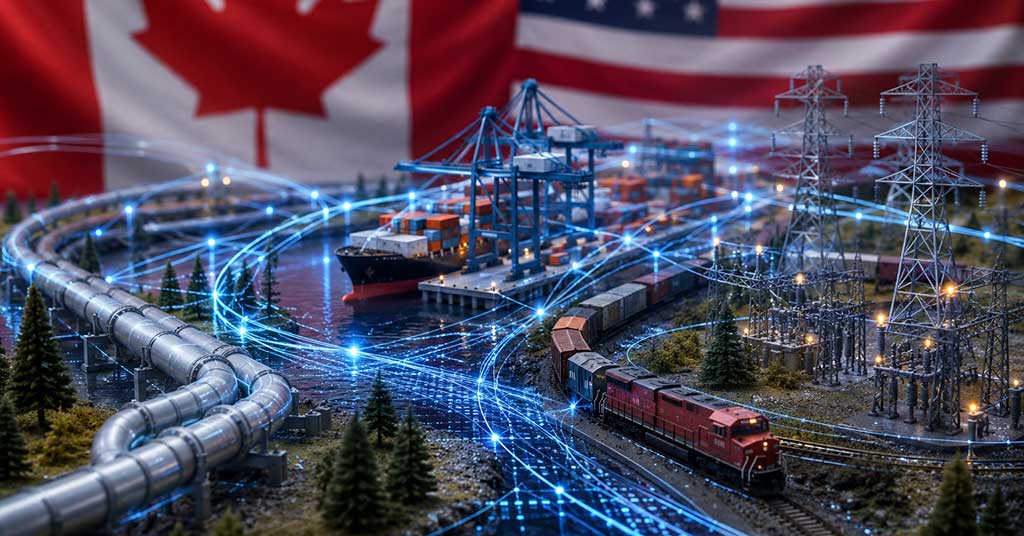
Foreign spies and cartels are undermining Canada’s critical infrastructure
Pipeline announcements in Canada and the United States are about more than energy exports. They are reminders that the infrastructure driving North American prosperity is increasingly vulnerable to foreign interference, cartel activity and illicit finance.
On April 30, 2026, the White House granted Bridger Pipeline Expansion LLC a presidential permit for cross-border pipeline facilities at the Canada-U.S. boundary in Montana. Reuters reported that the proposal would use idle Keystone XL pipe in Canada and could increase Canadian crude exports to the U.S. by more than 12 per cent if completed. Two weeks later, Canada and Alberta announced an agreement under which Alberta will submit a proposal by July 1, 2026, for a bitumen pipeline to Asian markets capable of moving at least one million barrels per day.
Pipelines, ports, power grids, rail corridors, casinos, financial institutions, critical minerals and border crossings now sit inside a wider contest over economic security. Canada and the U.S. remain deeply integrated economies. That integration is a strength but creates vulnerabilities.
A North American security panel framed prosperity as a shared security problem. The issue is whether foreign state and criminal actors can exploit division faster than democratic institutions can respond.
The same actors operate on both sides of the border. China targets technology, critical minerals, research, supply chains, infrastructure and political narratives. Iran has used intelligence networks, criminal proxies and transnational repression. Cartels exploit precursor chemical supply, money laundering, firearms flows and transportation corridors. Canadian Security Intelligence Service reporting identifies China and Iran among the main foreign interference and espionage actors targeting Canada.
These actors do not need a single command structure to produce a shared effect. China-linked fentanyl precursor supply and Chinese money laundering networks support cartel activity. Cartels move drugs, cash, people and weapons through border corridors that lawful commerce depends on. Iran has shown willingness to use criminal proxies, including outlaw motorcycle group members, to pursue coercive objectives abroad.
The result is that foreign state activity, organized crime, illicit finance, cyber pressure and influence operations increasingly reinforce one another.
A firearms trafficking case illustrates the risk. U.S. prosecutors allege that a network moved illegally obtained firearms from New Hampshire through Akwesasne territory, which spans parts of Ontario, Quebec and New York state, and into Canada, where some weapons were recovered at crime scenes.
The same vulnerability applies to corporate subversion through commercial relationships. First Nations economic development corporations, resource partnerships, port ventures, casino ownership and critical mineral projects can be targeted through apparently legitimate investment and commercial relationships, including shell companies, consultants, brokers and financing structures.
Casino ownership transitions in Western Canada should be considered in this context. Recent reporting shows that eight British Columbia casinos and two Alberta casinos have either changed hands or are in transition, with First Nations groups involved in those sales.
The risk is not Indigenous economic participation. The risk is that Indigenous partners may be targeted because of their strategic economic position.
The Cullen Commission, the public inquiry into money laundering in British Columbia, found that, between 2008 and 2018, Lower Mainland casinos accepted hundreds of millions of dollars in cash proceeds of crime through the Vancouver model, a money laundering system linking organized crime, underground banking and B.C. casinos.
Cash facilitators affiliated with criminal organizations provided large sums of illicit cash to casino patrons, including patrons with wealth in China who faced currency export restrictions. In 2014, British Columbia casinos accepted nearly $1.2 billion in cash transactions of $10,000 or more, including nearly $200 million reported as suspicious.
Warning indicators existed before the public inquiry. Cullen materials record intelligence work involving River Rock high-limit rooms, cash buy-ins, suspicious transaction verification and banned cash facilitators. Peter German’s Dirty Money Part 2 described Greater Vancouver as a laundering environment for Mainland Chinese, Mexican cartels, and Iranian organized crime, including alleged intersections with Hells Angels networks.
The policy lesson is straightforward. Energy infrastructure, casinos, fentanyl precursors, firearms, cyber espionage, foreign interference and Indigenous economic development should not be treated as unrelated files. They form part of the same prosperity-security system.
Canada and the United States need practical unity: investment screening, beneficial ownership enforcement, fentanyl finance targeting, scrutiny of foreign-linked corporate structures, protection for Indigenous governments and businesses, resilient energy and port infrastructure, and integrated border enforcement against firearms, narcotics, human smuggling and illicit finance.
The pipeline announcements are reminders that prosperity now depends on security, and security depends on economic resilience. Foreign state and criminal actors have learned to profit from division. Canada and the United States need to strengthen shared prosperity.
Scott A. McGregor is a senior fellow with the Frontier Centre for Public Policy and managing partner of Close Hold Intelligence Consulting Ltd. He is co-author of The Mosaic Effect: How the Chinese Communist Party Started a Hybrid War in America’s Backyard.
Explore more on Energy security, National security, Infrastructure
The views, opinions, and positions expressed by our columnists and contributors are solely their own and do not necessarily reflect those of our publication.
Troy Media empowers Canadian community news outlets by providing independent, insightful analysis and commentary. Our mission is to support local media in helping Canadians stay informed and engaged by delivering reliable content that strengthens community connections and deepens understanding across the country.

