
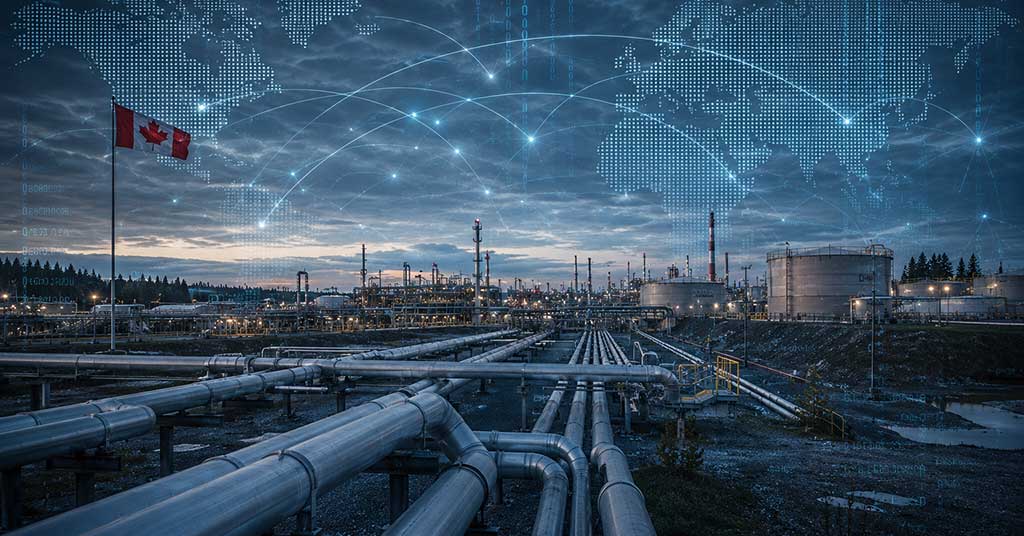
Canada exports the very fuel some provinces need because we haven’t built the pipelines to move it across the country
“Build Canada Strong” will not survive under the current and accelerating global diesel shortage. Mining, softwood lumber, grain, rail, marine freight and long-haul trucking still run on diesel engines.
Crude oil must be refined before it becomes diesel, gasoline or jet fuel. A barrel of crude yields only about a quarter to a third of its volume as diesel; the rest is gasoline, jet fuel and heavier cuts. Lose your refineries and you end up exporting crude oil while importing the fuels made from it.
Quebec, Ontario and British Columbia imported a combined 173,000 barrels per day in refined petroleum products in 2025. Newfoundland and Labrador also depends on imports. Most come from the United States.
Since the early 2000s, Canada has closed several refineries, including Petro-Canada’s Oakville plant, Shell’s Montréal refinery, Imperial Oil’s Dartmouth refinery and the Bowden plant in Alberta. The Come By Chance refinery in Newfoundland closed before reopening to produce renewable diesel.
Refinery closures have also swept through the U.S. and Europe, which have lost dozens of plants since 2010. The Breakthrough Institute’s 2025 study, “How California Regulated Itself Into an Energy Crisis”, emphasized the role of regulations in California refinery closures.
Plants that remain face biodiesel mandates, tight sulphur and emissions rules, cap-and-trade, industrial carbon charges, and lenders that will not finance new refineries. Governments cannot keep making refineries more expensive to operate and then complain when investment goes elsewhere.
Meanwhile, the Global South rebuilt the refineries the West retired. Mega-refineries in Kuwait, Saudi Arabia and Nigeria came online without the Western permitting stack.
From 2022 to 2026, the bill came due. Global diesel markets have been hammered by Ukrainian strikes that Kyiv says disabled more than 50 per cent of Russian refining capacity, disruptions to shipping through the Strait of Hormuz and China suspending most fuel exports. Dalhousie University data show the near doubling in Canadian diesel prices following the invasion of Ukraine in 2022.
Yet Canada is a net diesel exporter because of refining capacity in Alberta and New Brunswick. Transportation costs and limited east-west infrastructure make imports more economical for some provinces.
Canada has both a refining policy problem and an east-west transportation problem. The easiest answer is that Ottawa must stop penalizing Canadian refineries for emissions from the natural gas they burn to make diesel.
At a $95-a-tonne industrial carbon price in 2026, refiners face costs for emissions exceeding applicable performance standards. The cost depends on the refinery and provincial pricing system, but still makes Canadian refining more expensive. This structural penalty raises production costs that can be passed to consumers at the pump.
The Clean Fuel Regulations (CFR), in force since July 2023, impose compliance costs on fuel producers and importers. Federal estimates indicate they could increase diesel prices by seven to 16 cents a litre by 2030, measured in 2021 dollars.
Ottawa eliminated the consumer carbon price on April 1, 2025, but kept industrial carbon pricing, which imposes compliance costs on large emitters. Ottawa can and must eliminate both the industrial carbon tax and the CFR.
But that alone will not fix the lack of east-west transportation infrastructure essential to energy sovereignty.
Canada’s largest refinery, Irving, can process about 320,000 barrels of crude a day. More than half its finished products are exported to the northeastern United States.
Ottawa should issue an emergency permit for a refined-products pipeline from Irving’s Saint John refinery to Québec City, under a fixed review clock and a single federal approval.
This would give Quebec better access to diesel and other fuels refined in Canada, rather than leaving so much production destined for New England. A medium-size pipeline is much easier to build than a new refinery.
Canada cannot claim to be building a stronger country while penalizing its own refineries and leaving Canadian industries dependent on foreign fuel supplies.
Dr. Joseph Fournier is a senior fellow at the Frontier Centre for Public Policy. An expert in economic analysis and structural policy, his research focuses on productivity, regional migration and sustainable economic renewal in Canada.
Explore more on Energy security, Pipelines, Energy sector, Carbon tax, Infrastructure
The views, opinions, and positions expressed by our columnists and contributors are solely their own and do not necessarily reflect those of our publication.
Troy Media empowers Canadian community news outlets by providing independent, insightful analysis and commentary. Our mission is to support local media in helping Canadians stay informed and engaged by delivering reliable content that strengthens community connections and deepens understanding across the country.

