
Thirteen years after the Lac-Mégantic explosion, rail safety is an illusion built on corporate greed
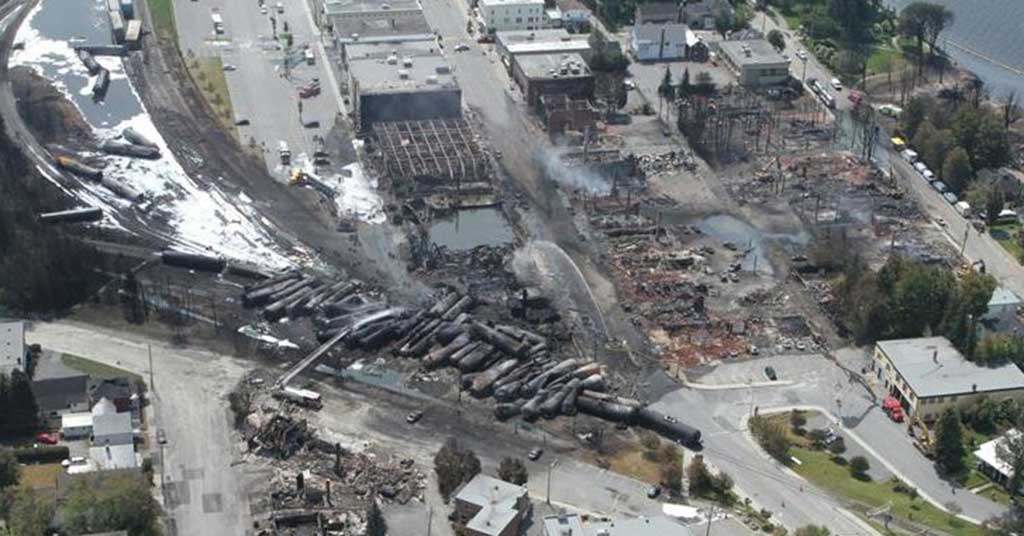
Thirteen years ago, on July 6, 2013, a runaway train carrying 72 tank cars of volatile shale oil derailed and exploded, obliterating the centre of the historic town of Lac-Mégantic. That night, 47 people died, and 27 children lost their parents.
The Lac-Mégantic disaster was the consequence of a decades-long trajectory of mutually reinforcing policies—deregulation, fiscal austerity, privatization—that enhanced corporate self-regulation and systematically eroded safety protections.
Today the federal government is moving at warp speed to “remove red tape,” which it sees as obstructing its economic objectives and private sector priorities. Its planned cuts to the public service workforce will undoubtedly include cuts to regulatory agency staff.
The power relationship between the government regulator and the regulated industry—regulatory capture—was a central contributing factor to the tragedy, repeatedly subverting public safety to profit.
Industry executives and owners blamed the locomotive engineer and two frontline staff, but the deck was stacked so heavily against these employees that calamity was inevitable. Investigators laid charges against the employees, but they were acquitted. No corporate executives or owners were charged. No senior government officials have been held to account.
The victims’ families filed a class-action lawsuit and, in 2015, they reached a combined settlement creating a $460-million victims’ compensation fund. CP Rail (now CPKC) refused to pay into the fund, stating it bore no responsibility for the tragedy. In May 2025, the Supreme Court of Canada ended efforts to sue CPKC over its responsibility, declining to hear an appeal.
Major railways in Canada have their own police forces with full investigative and jurisdictional powers. They have authority to enforce all federal and provincial laws within 500 metres of railway property.
In June 2025, rail safety activist Robert Bellefleur, responding to worries from neighbours about a collapsing culvert under the railway tracks, took photos and sent them to the company. Three days later, a CPKC maintenance crew repaired it. CPKC sent two armed private police officers to Bellefleur’s home, accusing him of illegal entry. Quebec’s Director of Criminal and Penal Prosecutions (DPCP) issued a fine of $700, including legal fees, against Bellefleur. He decided to pay the fine since fighting it in court would have been costly.
The federal Transportation Safety Board (TSB) created a watchlist to highlight “those issues posing the greatest risk to Canada’s transportation system” that need to be rectified by Transport Canada.
Its most recent 2025 watchlist highlighted a number of long-time systemic safety issues, including fatigue management, safety management, and crews failing to recognize and follow signal indications. Drug and alcohol impairment issues were added to the latest watchlist.
Currently, four to six CPKC trains, each consisting of 225 freight cars and tankers carrying hazardous goods, pass through Lac-Mégantic daily. These trains often measure over 3.8 kilometres long. In 2018, the federal and provincial governments committed to funding a bypass around the town centre. Upon completion, Canadian Pacific Kansas City (CPKC) will own and manage it.
In September 2025, the Canadian Transportation Agency (CTA) received CPKC’s application to construct the bypass. The CTA approved the application on July 16.
The government, the railway corporations and the justice system have failed the people of Lac-Mégantic.
The government continues to delay implementing safety measures necessary to diminish the probability of a recurrence. As the Environmental Commissioner in the Auditor General’s Office warned, “The window for a recurrence of a Lac-Mégantic-type disaster is still open.”
Bruce Campbell is the former executive director of the Canadian Centre for Policy Alternatives. He authored The Lac-Mégantic Rail Disaster: Public Betrayal, Justice Denied (Lorimer, 2018).
Explore more on Deregulation, Transportation, Public safety, Federal politics, Law
The views, opinions, and positions expressed by our columnists and contributors are solely their own and do not necessarily reflect those of our publication.
Troy Media empowers Canadian community news outlets by providing independent, insightful analysis and commentary. Our mission is to support local media in helping Canadians stay informed and engaged by delivering reliable content that strengthens community connections and deepens understanding across the country.

