
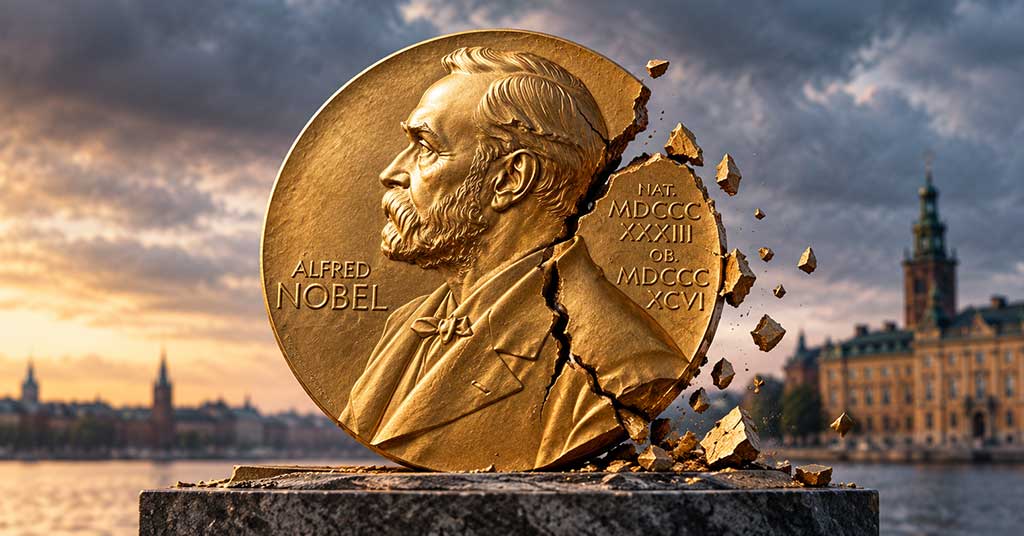
The committee has betrayed its legacy by honouring Navi Pillay
Her award was hailed in particular by pro-Palestinian sources who praised her for condemnation of various Israeli actions as genocidal. Some Jewish voices were less enthused. Elisha Wiesel, son of Elie Wiesel, winner of the prize in 1986 for his work on Holocaust awareness, complained, “My father, Elie Wiesel, received the Nobel Peace Prize for ensuring the Holocaust wouldn’t be forgotten. By honoring Navi Pillay, who accused Israel of genocide, the committee has betrayed his legacy.”
With due respect to both Pillay and Wiesel, neither of them deserved the Nobel Peace Prize.
Alfred Nobel (1833–1896) was a Swedish chemist and industrialist who made a fortune from investing in the arms industry and from inventing high explosives like dynamite and gelignite. In his will, he left the bulk of his fortune to fund prizes given annually for advances in chemistry, physics, physiology or medicine, and literature. His will also mandated a prize for “the person who shall have done the most or the best work for fraternity between nations, the abolition or reduction of standing armies and for the holding and promotion of peace congresses.”
Nobel’s interest in an award for the promotion of peace came out of a powerful European movement in the late 19th century, which called for greater international cooperation, a renunciation of military conflict, and agreements on the laws of combat. A series of peace congresses, meetings of parliamentarians, and diplomatic meetings, such as the Hague Conferences of 1899 and 1907, led many in the first years of the 20th century to think the continent might finally agree to abolish the scourge of war.
Nobel’s Peace Prize, first given in 1901, rewarded those men and women involved in this movement and those statesmen who facilitated peace treaties. A notable example was American president Teddy Roosevelt, who engineered a halt to the Russo-Japanese War in 1905.
This emphasis on recognizing those who advocated for peace and those who worked to end conflicts continued for decades under the Nobel Committee (chosen by the Norwegian parliament). Naturally, when the world was on the brink of war or in actual conflict, it was sometimes impossible to find a worthy recipient and no Peace Prize was awarded.
This began to change in the years after the Second World War. Though diplomats such as American Ralph Bunche (1950) and Canadian Lester Pearson (1957) were rewarded for their work on ending the first Israeli-Arab war and the Suez Crisis, it was increasingly likely that the Nobel Peace Prize would be given to highlight some worthy cause.
Albert Schweitzer, a missionary doctor and musician, received his in 1952 for “altruism, reverence for life, and tireless humanitarian work”; in 1969 it was the turn of the International Labour Organization “for creating international legislation insuring certain norms for working conditions in every country”; while Mother Teresa in 1979 was honoured for “her work for bringing help to suffering humanity.” Laudable as these efforts were, none of them came close to fulfilling the conditions Alfred Nobel had stipulated in his will.
Sometimes the awards were meant to shine a spotlight on causes dear to the hearts of the Norwegian elite and to interfere in the politics of unpopular regimes. Thus the awards to Albert Lutuli (1960) and Desmond Tutu (1984) for anti-apartheid stances in South Africa; to anti-Soviet dissident scientist Andrei Sakharov (1975); to Lech Walesa (1983) for trade unionism in communist Poland; and to Aung San Suu Kyi (1991), leader of a pro-democracy movement in Burma.
In some cases, the Peace Prize might serve as a kind of publicity shield against local government reprisals. It worked for Walesa and Sakharov but failed utterly for Liu Xiaobo (2010), who would die in jail for advocating democratic reform in China.
Very occasionally, it was still possible to be awarded the prize for bringing an end to a war. Henry Kissinger and Le Duc Tho were offered the prize in 1973 for arranging a ceasefire in Vietnam (Tho refused his); Anwar al-Sadat and Menachem Begin were honoured in 1978 for arranging an Egyptian-Israeli peace treaty; and Yasser Arafat, Shimon Peres and Yitzhak Rabin in 1994 for an Israeli-Palestinian accord.
Overwhelmingly, however, the Nobel Peace Prize has become a lighthouse of virtue signalling, alerting the world to the political preferences of a handful of Norwegian politicians of the day. The most egregious examples of this can be seen in the awards to two American politicians, Al Gore (2007) and Barack Obama (2009). Gore ostensibly received his for his efforts to raise awareness of climate change, including his documentary An Inconvenient Truth, but more realistically as a consolation prize for losing the 2000 presidential election to George W. Bush.
Gore’s efforts toward ending war, though slight, tower above those of Obama, who was honoured less than a year after taking office and having accomplished many stirring words and photo-ops. Though the Nobel Committee noted Obama’s plan to withdraw American troops from Iraq (accomplished in 2011), Obama sent forces back into the country in 2014, where they remained until September 2026. We must also note that president Obama authorized the targeted killing without trial of American citizens.
There is no doubt that individual Peace Prize winners such as Martin Luther King Jr., Jimmy Carter, Mother Teresa, Malala Yousafzai, and Nelson Mandela and organizations such as Doctors Without Borders and the International Red Cross are ornaments of humanitarianism. They all deserve our praise and a whopping great award but not the Nobel Peace Prize as its founder meant it.
A genuine peace prize would have recognized the 2020 signing of the Abraham Accords, by which several Arab countries agreed to normalize diplomatic relations with Israel: opening embassies, starting direct flights, and cooperating on trade, tourism, technology and security. This was a crucial step toward reducing hostilities in the Middle East. Here was precisely the sort of achievement Nobel had in mind.
Why was this not done? It’s clear that there was nothing that could induce the committee to give an honour to characters it considered international pariahs, men such as Israeli prime minister Bibi Netanyahu and Jared Kushner (Donald Trump’s son-in-law). But the whole point of a peace prize is that it must recognize unsavoury characters who have put down their arms, like the former Vietnamese, Israeli, Palestinian, Irish and South African terrorists who won the Nobel Prize in the 20th century.
I encourage the Norwegian government, with its petro-trillions of dollars, to set up a new award for people doing an assortment of good things for humanity and let the Nobel Peace Prize voters get back to rewarding those who actually succeed in reducing the threat of war.
Gerry Bowler is a Canadian historian, the author of several books on culture and European and social history, and a senior fellow of the Frontier Centre for Public Policy.
Explore more on Nobel Prize, War/Conflict, History
The views, opinions, and positions expressed by our columnists and contributors are solely their own and do not necessarily reflect those of our publication.
Troy Media empowers Canadian community news outlets by providing independent, insightful analysis and commentary. Our mission is to support local media in helping Canadians stay informed and engaged by delivering reliable content that strengthens community connections and deepens understanding across the country.

